How Classical Conversations Supports Students and Parents Alike
Have you ever wondered if your child can receive college credit for the homeschool coursework he is already doing? Now he can! With Classical Conversations Plus, a concurrent enrollment homeschool option, your child can earn college credit while participating in classes already on the schedule. Although it might seem intimidating to teach high school courses that qualify for college credit, support is available with the Classical Learning Cohort to help reduce prep time and provide confidence and clarity. You might even consider enrolling in Classical Conversations, Inc.’s Master of Arts program yourself to receive a master’s degree in Classical Studies. All of these options are exclusive offerings for Classical Conversations families.
What Makes Classical Conversations Plus Unique?
Many homeschool programs and colleges offer dual enrollment opportunities for high school students. Parents often share the pros and cons of these programs online. Some appreciate the flexible college credit homeschool options. Some families become overwhelmed when they must choose from a fixed set of course offerings. Additionally, some parents hesitate to place all instruction in the hands of a college professor because they are unsure which worldview will shape the course content.
Classical Conversations Plus eliminates these concerns by providing an opportunity to earn college credit for the Challenge classes that students are already taking within their Classical Conversations academic community. Parents can be confident that their children will be learning the approved and vetted curriculum taught both at home and by the tutors of their trusted community. Classical Conversations Plus works well for students looking to simply get a course or two under their belts or for students with a full college degree in mind. This program is not the same as dual enrollment; it is a unique opportunity to earn college credit while taking Classical Conversations classes at a fraction of the cost of traditional methods.
How Can You Earn College Credit at Home?
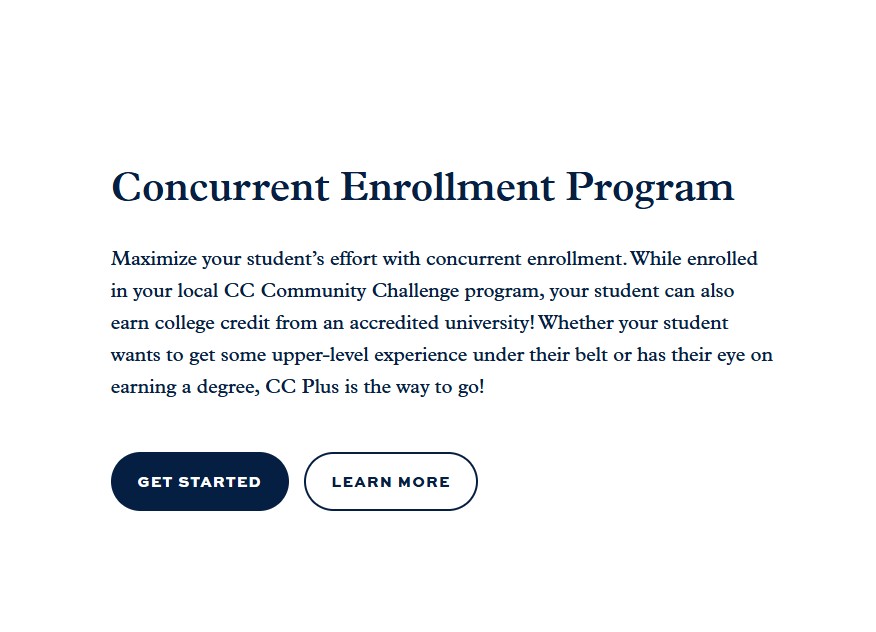
Classical Conversations has partnered with Southeastern University, a Christian institution of higher learning, to help students in Challenge 2, Challenge 3, and Challenge 4 obtain college credit through concurrent enrollment.
With concurrent enrollment, students upload and submit their coursework to a college assessor as they work through their courses with the rest of their community. Students receive feedback, a letter grade, and college credit for each approved course. Southeastern University accredits these courses, and students can transfer the credits to many colleges and universities.
Classical Conversations members (who have been members for at least a year) can log into the Classical Conversations site and view upcoming course offerings. These are organized by Challenge year, course code, course title, and semester. Some courses are only available in the fall or the spring semester. Some are offered during both semesters so you can choose when you want to take each class. Most courses line up with the Classical Conversations academic calendar.
What About Cost?
While the average four-year university charges around $390 per credit hour, Classical Conversations Plus charges only $160 per credit hour, saving you over $600 per course.
How Many Credits Will My Student Earn?
Most of the available courses are worth three (3) college credits each. Furthermore, students can earn up to sixty (60) transferable credits through their Classical Conversations community. By completing their existing coursework, they may reduce future college debt and accelerate their path toward a degree.
How Do I Get Started?
- Be enrolled in a Classical Conversations community for at least one year.
- Use your Classical Conversations login information to access the concurrent enrollment information.
- Take a look at the various registration date options.
- Check out when the next informational Zoom meeting will take place so you can hop on and have your questions answered directly, or use the information provided to set up an informational meeting that works for your schedule.
- Visit the Student Information Portal, which provides valuable information about the Classical Conversations Plus experience, complete with the current academic calendar and video tutorials to help you get registered.
Which Courses Count for Credit?
The following Classical Conversations courses are available for concurrent enrollment through Classical Conversations Plus.
Challenge 1
- Composition 1
- College Algebra
- Latin 1
- Western Cultural History
- Biology
For Challenge 2 Students
- American History 1
- American History 2
- Chemistry
- Composition 1
- Latin 2
- Music Theory
- Speech
- Philosophy
- College Algebra
Challenge 3
- Composition 2
- Greek and Roman Literature
- Interpretation of Ancient Literature
- Christian Thought and Practice
- Old Testament and Its Interpretation
- Western Civilization 1
- Western Civilization 2
- College Algebra
- Speech
Once logged in on the Classical Conversations site, take some time to click through a few of the courses that you know are coming up in your community to see which ones your student could count for credit. As you look through the courses, you will see specifically the type of content that will need to be uploaded and submitted in order to receive college credit, and which week each assignment will be due.
For example, an Invention and Arrangement Exercise might be due during Week Four of English Composition. The description for the required submission might read something along the lines of: “Based on the essay prompt in your Challenge II guide, you will submit a thesis, introductory paragraph, and outline of your essay for CC+ credit.”
In this case, the entire essay is not required. Students may be asked in cases such as this to submit pieces of their work throughout the process at specific intervals.
Classical Learning Cohort
Are you looking for more tools to help as you teach your child and tutor other students?
The Classical Learning Cohort provides bi-monthly sessions to aid you in your educational efforts—equipping you to guide children towards academic success. The cohort decreases prep time and helps you to focus on the main takeaway for each lesson. This offering provides you with an online or in-person group of six Classical Conversations members who meet bi-weekly (six times a semester) for four semesters. During these meetings, members learn from a seasoned mentor who goes through sample lessons. Members are also given the opportunity to lead mini-lessons and practice giving assessments.
Higher Education for Classical Conversations Parents
Classical Conversations parents who already possess a bachelor’s degree may be interested in pursuing a master of arts degree in classical studies through Classical Conversations.
FAQ
Why Concurrent Enrollment?
Concurrent enrollment helps students ease into the transition of college and/or work life. This option, available through Classical Conversations Plus, uses the courses that your student is already taking in Challenge 2, Challenge 3, and Challenge 4.
Is Concurrent Enrollment the Same as Dual Enrollment?
No. This option is not dual enrollment. Dual enrollment permits your student to take college courses in high school. This option provides college credit for the Classical Conversations courses that your student is already taking.
Will My Student Earn an associate’s degree through Concurrent Enrollment in Classical Conversations Plus?
A student counselor can guide interested students through the process of pursuing an associate’s degree while in the program.
Why wait, when you can start now? Connect with someone to find out more about Classical Conversations Plus and the Classical Learning Cohort today.
HomeschoolingFinds.com Author
Heather Vogler is a writer, speaker, and blogger. She lives on Garnet Creek Farm nestled in the Blue Ridge Mountains of Virginia. She has homeschooled for over fifteen years, with two homeschool graduates and three still homeschooling. Heather is the owner of Thrift Schooling, where she teaches families how to homeschool and homestead on a budget.